How Structured Information Environments Help Commercial Real Estate Deals Close Faster
3 min read76 views

Commercial real estate deals rarely slow down for only one reason.
More often, they slow down because the information environment around the deal keeps creating small points of friction that accumulate over time.
A missing file here. A vague update there. A version conflict that needs clarification. A buyer is following up twice on something that should already be resolved. A process that feels harder to track than it should be.
Individually, those issues may not look decisive.
Together, they shape the speed of the transaction.
That is why structured information environments matter.
In commercial real estate, buyers move faster when the deal is easier to understand, track, and trust. That does not happen by accident. It happens when the information around the transaction is built to support clarity rather than confusion.
This is the core lesson behind the full campaign.
We have already written about information asymmetry, due diligence friction, buyer confidence, seller responsiveness, document standardization, verified data rooms, version control, deal readiness, transaction visibility, communication gaps, document completeness, and buyer follow-up fatigue. These are not isolated problems. They are connected symptoms of one larger issue.
The quality of the information environment determines how heavy or how workable the deal feels.
What Is a Structured Information Environment in CRE?
A structured information environment in commercial real estate is a transaction setting where files, updates, process status, and next steps are organized clearly enough to support efficient decision-making.
This typically includes complete and organized document sets, clear version control, visible process tracking, specific and useful communication, minimal missing items, clear ownership of tasks, and easy access to current information.
It is not about having more data. It is about making the data usable.
Why Structured Information Environments Help Deals Close Faster
Structured information environments in commercial real estate help deals close faster because they reduce preventable friction across the entire transaction process.
When the information environment is strong, buyers do not waste time chasing basic documents, reconciling conflicting files, or guessing what has changed. Instead, they can focus on evaluating the opportunity.
Underwriting remains more efficient. Legal review stays aligned. Internal approvals move forward with less uncertainty. The overall process feels more coherent and manageable.
This improves deal speed naturally, not because urgency is forced, but because the transaction becomes easier to move through.
How Structure Affects Buyer Confidence
Structured information environments in commercial real estate directly influence buyer confidence.
Buyers trust processes that feel clear and understandable. When documentation is complete, versions are consistent, updates are specific, and deal status is visible, the transaction feels controlled.
This does not eliminate risk. It reduces the additional uncertainty created by weak execution.
Confidence is not built only through the asset. It is built through the experience of the transaction.
The more structured the environment, the less effort buyers need to stay informed and engaged.
What Happens in Unstructured CRE Deal Environments
In unstructured environments, the burden of maintaining the process shifts to the buyer.
Buyers spend more time chasing information, clarifying inconsistencies, cross-checking documents, and reopening issues that should have been resolved earlier.
As a result, more effort goes into managing friction and less into evaluating the opportunity.
This is when the transaction begins to feel heavier than it should.
A strong asset can withstand some complexity, but it becomes significantly harder to maintain momentum when the information environment continues to create avoidable work.
What a Strong CRE Information Environment Looks Like
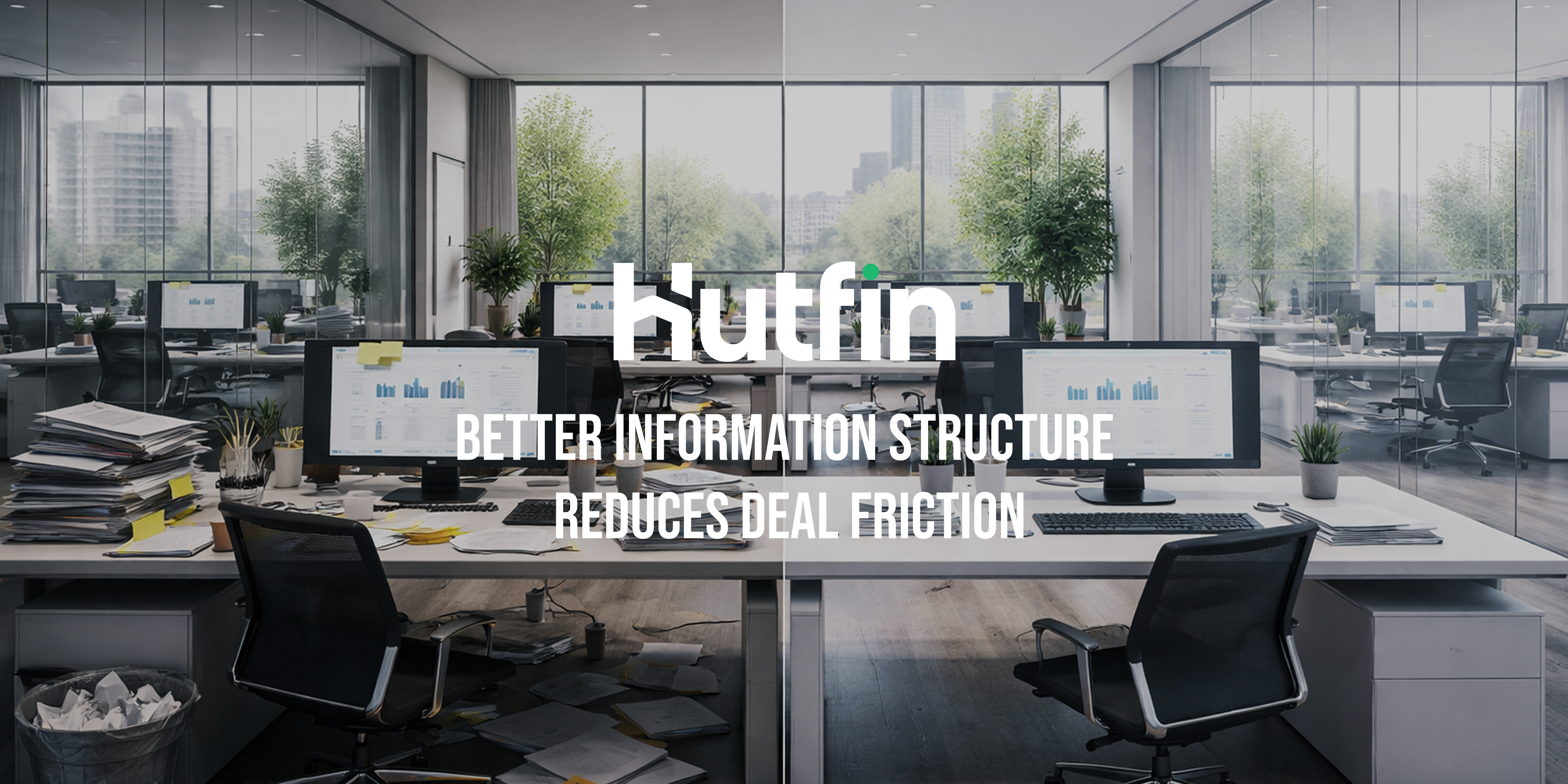
A strong, structured information environment is defined by consistent execution.
Documents are available and complete. Versions are clearly identified. Updates provide meaningful information. The process is easy to track. Open items are visible, and completed items are confirmed.
Buyers are not required to reconstruct the state of the deal from fragmented updates.
This level of structure does not simplify the transaction itself. It makes the transaction workable.
Why This Matters for Modern CRE Platforms
For modern CRE platforms, improving deal flow requires improving the information environment around transactions.
Listings alone are not sufficient. Access to data alone is not enough. Claims of speed do not create real efficiency.
Platforms must support transactions by making them clearer, more structured, and easier to manage.
That is what an effective transaction infrastructure looks like.
Key Takeaway
Commercial real estate deals close faster when the surrounding information environment is structured well enough to reduce preventable friction.
Structured information environments in commercial real estate do not just make transactions appear organized. They make them easier to trust, evaluate, and close.